Facts checked Nov 19, 2026 against the sources listed below.
A conductor's contract demand, a hall built in one summer, a decade as a jazz house, near-demolition and a long restoration. These dates are from the DSO's own history pages, with Wikipedia where noted.
The orchestra before the hall
The Detroit Symphony gave its first subscription concert on December 19, 1887, at the Detroit Opera House. It stopped in 1910 and was restarted in 1913, when ten Detroit women gave $100 each. Ossip Gabrilowitsch became music director in 1917 or 1918 (the DSO's pages give both).
Crane's hall, 1919
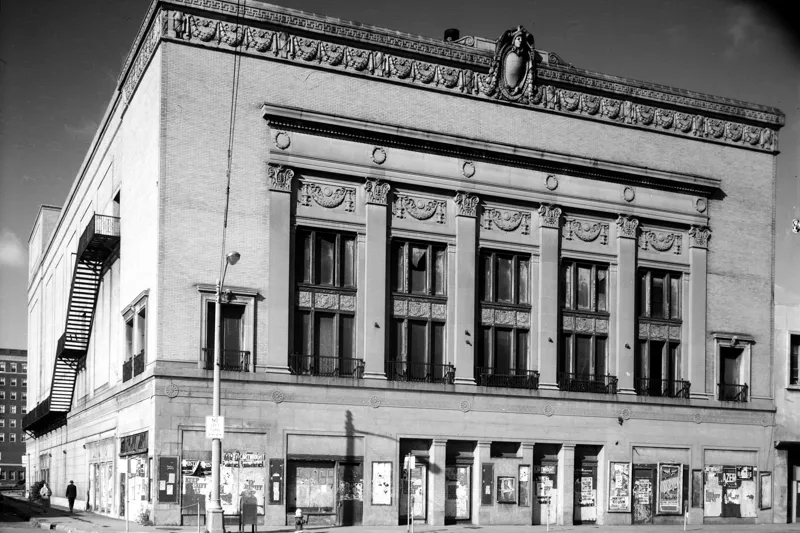
Gabrilowitsch made a new hall a condition of his contract. The Detroit Symphony Society bought the old Westminster Presbyterian Church site on Woodward in April 1919, and C. Howard Crane, who designed about 40 Michigan theaters including the Fox, built Orchestra Hall over that summer. It opened on October 23, 1919. In 1922 the DSO became the first orchestra to broadcast a concert on the radio, and in 1928 it played Carnegie Hall and made its first recording.
The Paradise Theatre
The orchestra left the hall in 1939. On December 26, 1941, it reopened as the Paradise Theatre with a Louis Armstrong concert and ran as a jazz and blues house until 1951; Wikipedia adds Ella Fitzgerald, Billie Holiday, Count Basie and Duke Ellington. The DSO, meanwhile, disbanded in 1942, was revived in 1944, disbanded again in 1949, and came back under Paul Paray in the early 1950s, moving to the riverfront Ford Auditorium in 1956.
Saved by a bassoonist
By 1970 the empty hall was in serious disrepair and faced demolition. The Save Orchestra Hall coalition, led by DSO bassoonist Paul Ganson, held off the wreckers. Restoration took nearly 20 years and over $6 million, and the orchestra moved back in 1989. The hall was listed on the National Register of Historic Places on April 16, 1971 (Wikipedia).
The Max, 2003
During Neeme Järvi's tenure the DSO completed the Max M. and Marjorie S. Fisher Music Center, a 130,000 square foot expansion around the hall that opened on October 11, 2003, with new lobbies, rehearsal space and a second, smaller venue (Wikipedia). Today the Max includes the William Davidson Atrium, the Cube, the Paradise Lounge and Sosnick Courtyard. The 2019–20 season celebrated the hall's centennial.
The music directors
Paul Paray (1951–62), Sixten Ehrling (1963–73, who led 722 concerts, the most of any DSO music director), Antal Doráti (1977–81), Günther Herbig, Neeme Järvi (1991–2005) and Leonard Slatkin (2008–18) led the orchestra before Jader Bignamini, introduced in January 2020 as the 18th music director. His contract runs through the 2030–31 season.
Where sources disagree
- Build time: "about six months" on the DSO's Orchestra Hall page, "four months and 23 days" on its orchestra history page.
- Gabrilowitsch's first year: 1917 (history) or 1918 (music directors list).
- Paradise opening: December 26, 1941 (DSO) or Christmas Eve 1941 (Wikipedia).
- Restoration cost: over $6 million (DSO) or about $6.8 million (Wikipedia).
The organ and the Max
In 1924 William H. Murphy and his wife gave the hall a large Casavant Frères organ; the French organist Marcel Dupré played its dedication concert on March 17, 1924. The 2002–2003 expansion that created the Max M. and Marjorie S. Fisher Music Center, known as "the Max", added lobbies, dressing rooms, rehearsal space and a smaller second venue for more intimate performances, now called The Cube. The hall also has a civic role: the mayor of Detroit gives the annual State of the City address there, according to Wikipedia.
Questions
Who designed Orchestra Hall in Detroit?
C. Howard Crane; it opened October 23, 1919.
What was the Paradise Theatre?
Orchestra Hall's name from 1941 to 1951, when it was a jazz and blues venue that opened with Louis Armstrong.
When did the DSO return to Orchestra Hall?
In 1989, after nearly 20 years of restoration led by the Save Orchestra Hall effort.
Does Orchestra Hall Detroit have an organ?
Yes. A Casavant Frères organ was given in 1924; Marcel Dupré played its dedication concert.
Sources
Checked Nov 19, 2026.